SKU: 71565402682
tex-lock fahrradschloss

tex-lock fahrradschloss Tex-Lock Eyelet U/X-lock S Fahrrad Kettenschloss und Mini U zertifiziert ART 2

Sale price$22.89 Regular price$25.43
Save 10%

Pay in installments of $6.36 with ShopPay, AfterPay and Klarna

Shipping Estimate
USA
  • USA
  • CAN

Ships within 48 hours · Estimated delivery Oct 16 - Oct 21

Promo Codes Available:

For Your Every Summer RSVP, with Code: SUMMER15

Description

tex-lock fahrradschloss Tex-Lock Eyelet U/X-lock S Fahrrad Kettenschloss und Mini U zertifiziert ART 2Das Tex Lock Eyelet U X lock ist ein 80 cm langes Kabel, das mit einem U Schloss kombiniert ist, um Ihr Fahrrad zuverlssig zu sichern. Tex Lock Eyelet U X lock Fahrradschloss mit Sold Secure und ART 2 Zertifizierung Schtzen Sie Ihr Fahrrad berall mit der Tex Lock Kettenschloss Serie. Dieses Schloss besteht aus einer textilen Faser mit sen und einem verstrkten Metallkern. Tex Lock hat die perfekte Balance gefunden zwischen hoher Sicherheit, Komfort fr

Das Tex-Lock Eyelet U/X-lock ist ein 80 cm langes Kabel, das mit einem U-Schloss kombiniert ist, um Ihr Fahrrad zuverlässig zu sichern.

Tex-Lock Eyelet U/X-lock Fahrradschloss mit Sold Secure- und ART-2-Zertifizierung

Schützen Sie Ihr Fahrrad überall mit der Tex-Lock Kettenschloss-Serie. Dieses Schloss besteht aus einer textilen Faser mit Ösen und einem verstärkten Metallkern. Tex-Lock hat die perfekte Balance gefunden zwischen hoher Sicherheit, Komfort für Radfahrer und elegantem Design. Die Marke bietet ein in Deutschland entworfenes und hergestelltes Schloss, das Hightech-Materialien, Stil und Leichtigkeit vereint.

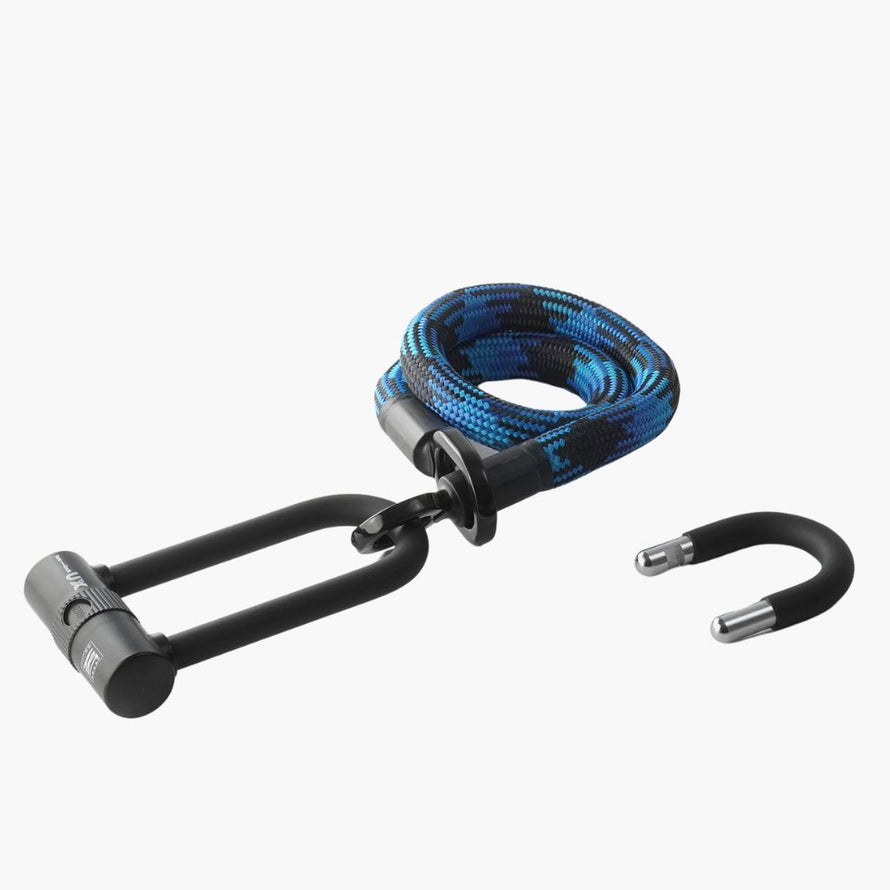
Jedes Ende des Schlosses ist mit verstärkten Metallösen versehen, die mit Kunststoff überzogen sind. Eine größere Schlaufe auf der einen Seite, eine kleinere auf der anderen: Führen Sie einfach die kleinere Schlaufe durch die größere, nachdem Sie den Fahrradrahmen an einem festen Punkt befestigt haben. Anschließend verschließen Sie das Ganze mit dem mitgelieferten Mini-U-Schloss mit Schlüssel.

Besonders wichtig: Die Eyelet-Schlösser der Marke Tex-Lock sind ART-2-zertifiziert für ihre ausgeklügelte Bauweise in Kombination mit dem Mini-U-Schloss, dessen Schließzylinder zusätzlich die Sold Secure Silver-Zertifizierung besitzt.

  • ART 2: Die ART-Stiftung vereint Vertreter aus Verbraucherschutz, Fahrradindustrie und Versicherungen, um ein Qualitätslabel für Fahrradschlösser zu entwickeln. Zwei Sterne kennzeichnen Schlösser, die speziell für Fahrräder geeignet sind. ART-2-Schlösser werden geprüft und zugelassen, bevor sie das Label erhalten.
  • Sold Secure: Eine britische Organisation, die Sicherheitstests für Schlösser durchführt. Die verschiedenen Stufen kennzeichnen den Widerstandsgrad gegenüber bestimmten Werkzeugen. Silver bietet ein hervorragendes Gleichgewicht zwischen Preis und Sicherheit.

Tex-Lock Kette und Mini-U-Schloss aus verstärkten Textilfasern mit Ösen

Wie ist das Eyelet-Schloss von Tex-Lock aufgebaut? Die Tex-Lock-Kette besteht aus einer patentierten mehrschichtigen Struktur aus Textilfasern. Jede Schicht erfüllt eine bestimmte Funktion und bietet außergewöhnlichen Widerstand gegen Bolzenschneider, Feuer und Sägen. Die weiche Oberfläche schützt außerdem den Fahrradrahmen vor Kratzern und verhindert unangenehme Geräusche beim Transport.

1 - Sägefest dank gehärtetem Stahlkern
2 - Hohe Widerstandsfähigkeit gegen Bolzenschneider durch spezielle Molekularstruktur
3 - Feuerfest dank hitzebeständiger Faserschicht
4 - Schutz des Fahrradrahmens durch weiches, flexibles Gewebe, das zudem die Handhabung erleichtert

Leichtes und komfortables Tex-Lock U/X-lock für urbane Radfahrer

Das Tex-Lock Eyelet ist in der Größe S erhältlich: 80 cm Länge, 2,4 cm Durchmesser und ein Gewicht von 700 Gramm (ohne Mini-U). Diese kompakte Größe macht es ideal für Stadtradler, Pendler und Multimodal-Fahrer. Leicht und platzsparend, überzeugt es zudem durch sein elegantes, schlichtes schwarzes Design. Es eignet sich auch für den Einsatz im MTB-, Rennrad- oder Touringbereich.

Das Mini-U-Schloss wird mit zwei Schlüsseln geliefert, wiegt 460 Gramm und hat einen Bügeldurchmesser von 12 mm. Das Gesamtgewicht von Kette + U-Schloss beträgt 1.160 Gramm. Damit gehört das Tex-Lock zu den leichtesten Schlössern der ART-2-Kategorie.

Für Radfahrer, die ein längeres Schloss für ihr Lastenrad oder zum Sichern mehrerer Fahrräder suchen, bieten wir die Tex-Lock 120 Kette und die Tex-Lock 160 Kette an. 

Wenn Sie kein U-Schloss möchten, wählen Sie das Tex-Lock Orbit Kabelschloss (100 cm).

Für optimalen Schutz können Sie Ihr Tex-Lock zusätzlich mit einem Alarm-Fahrradschloss kombinieren.

Shipping Notes
  • Free Standard Shipping on $100+ Orders to the USA.
  • Except Preorder products are shipped in 48 hours.
  • Delivery to the USA:
  1. Standard Shipping : 3-10 business days
  • If time is of the essence, please consider selecting expedited delivery for faster service.
Exchange/Return Notes
  • We offer a 30-day return/exchange service after receiving.
  • Final sale items are not eligible for returns or exchanges.
  • To process your return/exchange, please contact us at [email protected]
  • Please click here for more details>>> Return & Exchange Policy
SKU: 71565402682

Discover Niche Categories That Outsell tex-lock fahrradschloss

Top-Converting Item to Boost Your Average Order

4.6 ★★★★★
Based on 9 reviews
Sort
Highest Rating
Newest First
Oldest First
Product Reviews
C
Verified Purchase
Carolyn H.
San Leandro, US
★★★★★ 1
Technical evaluation of the Taiwan_China ongoing situation
Format: Hardcover
I thought it was a novel. It isn’t. It’s way too technical for light reading.
WAS THIS REVIEW HELPFUL?YesReportShare
Reviewed in the United States on April 27, 2026
A
Verified Purchase
A. Menon
Birmingham, US
★★★★★ 5
Illuminating perspective on the evolution of thought of the political leadership in Iran
Iran's Grand Strategy is a well timed overview of the why's of Iran's leadership political outlook and the historical path that has taken them to where they are today. The book was written before this war has erupted between Israel/US and Iran and so discusses the political economy under the leadership of Khomeini and Khamenei, but it gives enough substance to allow the reader to translate this historical perspective into an understanding of the internal dynamics of Iran in this moment, something that is probably largely absent from the political calculus of the US when it made its decision to join Israel's strike The book is a work of political science and the history that has defined it. As such it starts with the Iranian revolution, the background to it, the politics of that day (which was mixing both socialist a-religious political groups with a religious political agenda for which the latter seized power) and how the leadership never really had a popular mandate to rule the country but consolidated power after broad discontent. Iran was subsequently really shaped by its war with Iraq and in many ways was a war of attrition and opportunism to varying degrees through time. Nonetheless this war shaped the leaderships views of how to govern and how to frame their mandate which was as the saviour of the country which would have to sacrifice to endure. Iran was the subject of chemical warfare, for which there were no sanctions. The US was seen to have subsidized Saddam's war initiative which provided ideological substance for considering the US as an enemy. The relationship with Israel is also discussed and how Iran took up the mantle of support for Palestinians as the much of other parts of the Middle East focused on a more narrow self interest. This period was define by the author's term Sacred Defence, where existential survival was the message for enlisting. This is also highlighted as how the regime became more defined by its security needs as determined by the IRGC rather than by the clerics. This phase shift has stuck and the author views much of the religious rationalization of political strategy as founded in security calculations from leadership of the IRGC along with the Ayatollah. This is why much major business is controlled by the IRGC and the Khamenei's son was projected to become the next leader despite hereditary rule as being anathema to an Islamic republic. The author discusses how Iran repurposed itself as an axis of resistance to US hegemony that was founded in its wartime survival mentality. That this largely has not carried over to its population despite it being fundamentally entrenched in much of the IRGC. The various democratic initiatives pursued often backfired as the leadership was voted against in parliamentary elections, though the real influence on politics was minimal given the Ayatolla's dominance. This transition of interest of the population and obstinance of the leadership led to increasing civil unrest and a pick up in protesting in the aftermath of the regional overthrows that took place in Egypt, Libya etc.. These episodes also further highlighted how the nuclear program remained a core asset for preventing external influence given Libya's voluntary decision to cease its nuclear program did Ghaddafi no favors at the time of being overthrown. These highlight the self preservation of Iran's leadship as being independent of the will of the people which is why there is fundamental disillusionment in the country of the future based on the existing political economy. The author spends time on the concept of Forward Defense, a guerilla warfare type mentality of the leadership to fill the power vacuum that emerged with the fall of Saddam. This had other regional reverberations in increased skirmishes with Israel through proxies and some religions fighting in Sunni/Shiite with Saudi and the Houthis as an example. Thus in the pursuit of resistance Iran ignored the externalities to regional players which have forced more isolation on Iran which is stuck in the past in its mindset and increasingly alone. This Forward Defense is part of the reason why settling on nuclear deals and having any mutual grounds for trust with the US has been impossible, with both sides having legitimate reasons for complete absence of trust. As such where we are today though not inevitable was never impossible. Overall this book was written for context of Iran's political calculus with no prediction for the current conflict but it is useful for that goal. I feel more informed for reading it and have a better perspective on why the views are as they are. It is also hard to deny there has been significant pettiness mixed with deep conflicting strategic interests that have led to the frictions on display in the last 20 years. Core interests will be difficult to reconcile, but the pettiness adding further barriers is getting more absurd by the day. Nonetheless if one wants to get some healthy perspective this is a solid book.
WAS THIS REVIEW HELPFUL?YesReportShare
Reviewed in the United States on March 26, 2026
S
Verified Purchase
STEPHEN SWENERTON
Carnegie, US
★★★★★ 5
EXCELLENT RESOURCE
Format: Hardcover
OUTSTANDING SUMMARY OF THE EVENTS LEADING UP TO THE CURRENT VERY UNFORTUNATE SITUATION. I USED IT AS MY PRIMARY SOURCE FOR A CLASS I AM TEACHING ON THE SUBJECT OF THE WAR IN IRAN.
WAS THIS REVIEW HELPFUL?YesReportShare
Reviewed in the United States on May 24, 2026
M
Verified Purchase
Max
Houston, US
★★★★★ 5
an excellent reference book
Format: Hardcover
At a time when the U.S. and Israel’s military operation against Iran has become one of the most important issues on the global agenda, this is an excellent reference book that summarizes the historical development of events and provides valuable context for better understanding what is happening today.
WAS THIS REVIEW HELPFUL?YesReportShare
Reviewed in the United States on May 11, 2026
M
Verified Purchase
Mr. Flex
Phoenix, US
★★★★★ 5
Great for better understanding Iran's strategic perspectives
Format: Hardcover
The book moves through the growth of Iran's strategic history since the 1979 revolution. By the time it gets to the last 100 pages its very interesting as far as understanding Iran's perspective. Also found it chilling how foreboding many parts were in light of what is happening right now
WAS THIS REVIEW HELPFUL?YesReportShare
Reviewed in the United States on March 2, 2026

recommand products